Prepared by the Editorial Team of Technology Magazine by Sulafa
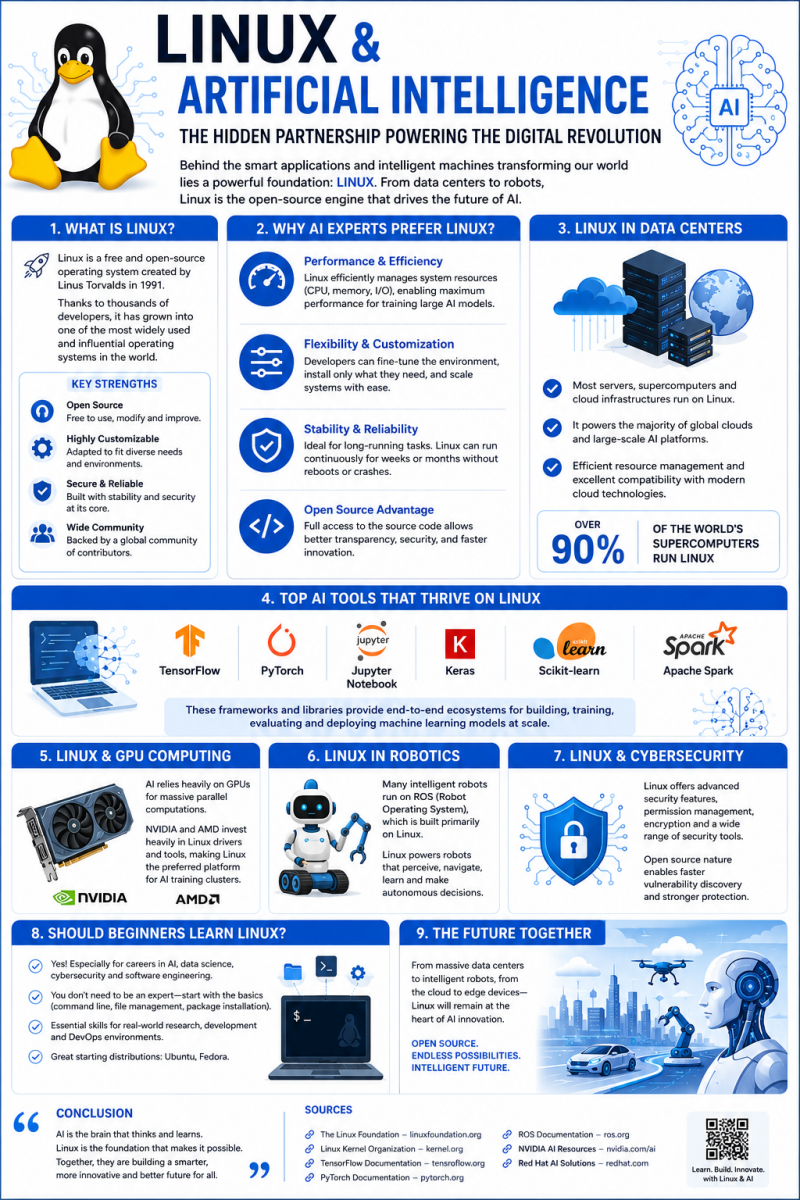
Keywords: Linux, Artificial Intelligence (AI), Open Source, Robotics, GPU Computing
In recent years, artificial intelligence has emerged as one of the most influential forces shaping technological, economic, and scientific discussions worldwide. From intelligent virtual assistants that answer our questions to autonomous vehicles, medical diagnostics, and large-scale data analytics, AI is transforming nearly every aspect of modern life. Yet behind this technological revolution lies a powerful infrastructure that often receives far less attention: the Linux operating system.
While many users may know little about Linux, it remains one of the most significant technologies behind the evolution of the Internet, cloud computing, and artificial intelligence. Today, the relationship between Linux and AI has become increasingly strategic, with each playing a vital role in shaping the future of digital innovation.
## What Is Linux?
Linux is an open-source operating system originally introduced by Finnish software engineer Linus Torvalds in 1991. What began as a modest operating system kernel rapidly evolved through the contributions of thousands of developers worldwide, becoming one of the most widely deployed and influential operating systems in history.
The strength of Linux lies in its open-source nature, which allows anyone to inspect, modify, improve, and distribute its source code. This flexibility has led to the development of numerous Linux distributions, including Ubuntu, Fedora, Debian, and Arch Linux, each designed to serve different communities, industries, and research environments.
## Why Do AI Professionals Prefer Linux?
Several factors have made Linux the platform of choice for artificial intelligence researchers, engineers, and data scientists.
### Superior Performance and Efficiency
Modern AI models require extraordinary computational power. Training large language models and deep neural networks often involves processing billions of parameters, making efficient resource management essential. Linux is renowned for its ability to optimize memory allocation, processor utilization, and system performance, allowing AI workloads to operate at maximum efficiency.
### Flexibility and Customization
One of Linux’s greatest advantages is its adaptability. Developers can tailor their operating environments to meet the precise requirements of their projects by installing only the necessary components and removing unnecessary overhead. This level of customization contributes significantly to improved performance and scalability.
### Reliability and Stability
Training advanced AI models may take days, weeks, or even months of continuous computation. Such demanding workloads require an operating system capable of maintaining long-term stability without interruptions or performance degradation. Linux has earned a reputation as one of the most reliable platforms for mission-critical computing environments.
## Linux and Large-Scale Data Centers
Whenever a user interacts with an AI service or cloud platform, the request is often processed not on the local device but within vast networks of servers located in data centers around the world.
The overwhelming majority of these servers run Linux. Industry reports consistently indicate that Linux powers most of the world's supercomputers, cloud infrastructures, and enterprise-scale computing environments. Its efficiency, scalability, and compatibility with modern cloud architectures make it the preferred choice for organizations managing massive computational workloads.
As a result, Linux has become a foundational component of the infrastructure supporting artificial intelligence applications, big data analytics, and cloud-based services across the globe.
## Leading AI Tools on Linux
Most of the world's most influential AI frameworks and development tools perform exceptionally well in Linux environments, including:
- TensorFlow
- PyTorch
- Jupyter Notebook
- Keras
- Scikit-learn
- Apache Spark
These technologies provide researchers and developers with comprehensive ecosystems for building, training, testing, and deploying sophisticated machine learning models at scale.
## Linux and GPU Computing
Contemporary artificial intelligence relies heavily on Graphics Processing Units (GPUs), which are capable of performing millions of parallel computations simultaneously.
Technology leaders such as NVIDIA and AMD have invested significantly in developing Linux-compatible drivers and software ecosystems. Consequently, many of the world's largest AI training clusters operate within Linux environments powered by advanced GPU architectures, enabling unprecedented levels of computational performance.
## The Role of Linux in Intelligent Robotics
Linux extends far beyond servers and data centers. It also plays a crucial role in modern robotics.
Many advanced robotic systems are built using ROS (Robot Operating System), a flexible framework designed for creating intelligent robots capable of perception, navigation, communication, and autonomous decision-making. ROS is predominantly deployed on Linux distributions, making Linux an essential component in the future development of robotics and autonomous systems.
## Linux and Cybersecurity
As AI applications increasingly expand into sensitive sectors such as healthcare, finance, defense, and critical infrastructure, cybersecurity has become more important than ever.
Linux provides robust security mechanisms, advanced permission management systems, encryption capabilities, and extensive security monitoring tools. Furthermore, its open-source architecture allows security experts worldwide to inspect code, identify vulnerabilities, and contribute improvements, resulting in stronger and more resilient computing environments.
## Should Beginners Learn Linux?
The short answer is yes—especially for those interested in pursuing careers in artificial intelligence, data science, cybersecurity, or software engineering.
Becoming a Linux expert is not a prerequisite. However, learning basic command-line operations, file management, package installation, and system administration can provide a strong foundation for understanding the professional environments used by technology companies and research institutions worldwide.
Distributions such as Ubuntu and Fedora offer excellent starting points for newcomers eager to explore the Linux ecosystem.
## The Future of Linux and Artificial Intelligence
As global dependence on artificial intelligence continues to grow, the demand for reliable, scalable, and high-performance computing platforms will increase accordingly. Linux is exceptionally well-positioned to remain at the heart of this technological transformation.
From hyperscale data centers and cloud computing platforms to autonomous robots and embedded systems, Linux continues to serve as a catalyst for innovation, enabling organizations to push the boundaries of what intelligent systems can achieve.
## Conclusion
Linux may not be as visible to end users as AI-powered applications, but it operates behind the scenes as one of the fundamental pillars supporting the modern digital revolution. If artificial intelligence represents the brain that processes information and generates insights, Linux represents the infrastructure that empowers that brain to function, evolve, and scale.
Understanding the relationship between Linux and artificial intelligence offers more than a glimpse into current technological trends—it provides valuable insight into the future of computing itself. As AI continues to reshape industries and societies, Linux will remain one of the indispensable forces driving that transformation forward.
References
- The Linux Foundation
- Linux Kernel Organization
- TensorFlow Documentation
- PyTorch Documentation
- ROS Documentation
- NVIDIA AI Resources
- Red Hat AI Solutions