When financial technology gives a chance to those rejected by banks
In a world where financial worthiness is often measured by rigid numbers, millions of entrepreneurs remain outside the banking system — not because they are unqualified, but because they are “invisible” to traditional systems. This is precisely where artificial intelligence changes the equation.
In an inspiring TED talk, Mercedes Bidart raises a fundamental question: Can artificial intelligence provide a fair financial opportunity to those rejected by traditional banks?
The answer, as her experience reveals, is yes — and even more than that.
The Invisible Economy: The Problem Banks Ignore
Across many countries in Latin America, millions of people operate within the informal economy. They have no bank accounts, no credit records, and no financial history that banks can rely on.
Yet the paradox is this: these individuals possess something even more valuable — community trust.
In local markets, sellers do not necessarily need credit cards; they need a reputation. People know them, trust them, and extend credit based on long-term relationships. Bidart describes this as the “invisible currency” — trust.
However, this type of data does not appear in traditional financial systems, leading to widespread exclusion.
Artificial Intelligence as a Bridge to Financial Justice
This is where AI-powered Financial Technology (FinTech) comes in.
Instead of relying solely on traditional banking data, modern systems analyze:
- User behavior on mobile phones
- Text messages
- Social media activity
- Business-related videos
- Informal payment patterns
All of this is known as Alternative Data.
Using machine learning algorithms, this data is transformed into a digital financial identity through which creditworthiness can be assessed.
From “Unqualified” to “Eligible”: A Revolution in Credit Assessment
In the traditional system, if you have no credit history — you simply do not exist.
In the AI-driven model:
- Your behavior is analyzed
- The stability of your business is evaluated
- Your level of trust within your community is measured
This creates a new framework known as:
🔑 AI-powered Credit Scoring
This model depends not only on numbers, but also on human behavior and social patterns.
The result?
- Small loans starting from as little as $10
- Continuous model improvement through machine learning
- Access to formal financing for thousands of entrepreneurs
Breaking the Cycle of Financial Exploitation
One of the most dangerous consequences of financial exclusion is falling into the trap of predatory lending, where interest rates can become inhumane.
But with the rise of Smart Lending solutions:
- Fair loans can be offered
- Terms can be customized for each user
- Decisions can be based on real behavioral data
This transformation not only strengthens Financial Inclusion, but also contributes to reducing poverty and supporting local economies.
Toward a More Human Financial System
What this experiment proposes is not merely a technological innovation — it is a philosophical shift in how we understand “financial worthiness.”
Instead of asking:
“Do you have a bank record?”
The question becomes:
“How do you live, work, and interact with your community?”
This leads to a new concept in financial technology:
Human-Centered FinTech
A system where financial services are designed around people — not the other way around.
Challenges That Cannot Be Ignored
Despite its enormous potential, this model comes with serious challenges:
1. Digital Privacy
Collecting data from phones and social platforms raises concerns about protecting user privacy.
2. Algorithmic Bias
If models are not carefully designed, they may reproduce the same forms of discrimination they are supposed to eliminate.
3. Transparency
How can users understand why they were approved or denied a loan?
The Future of FinTech: Beyond Banks
We are witnessing a radical transformation in the structure of the financial system.
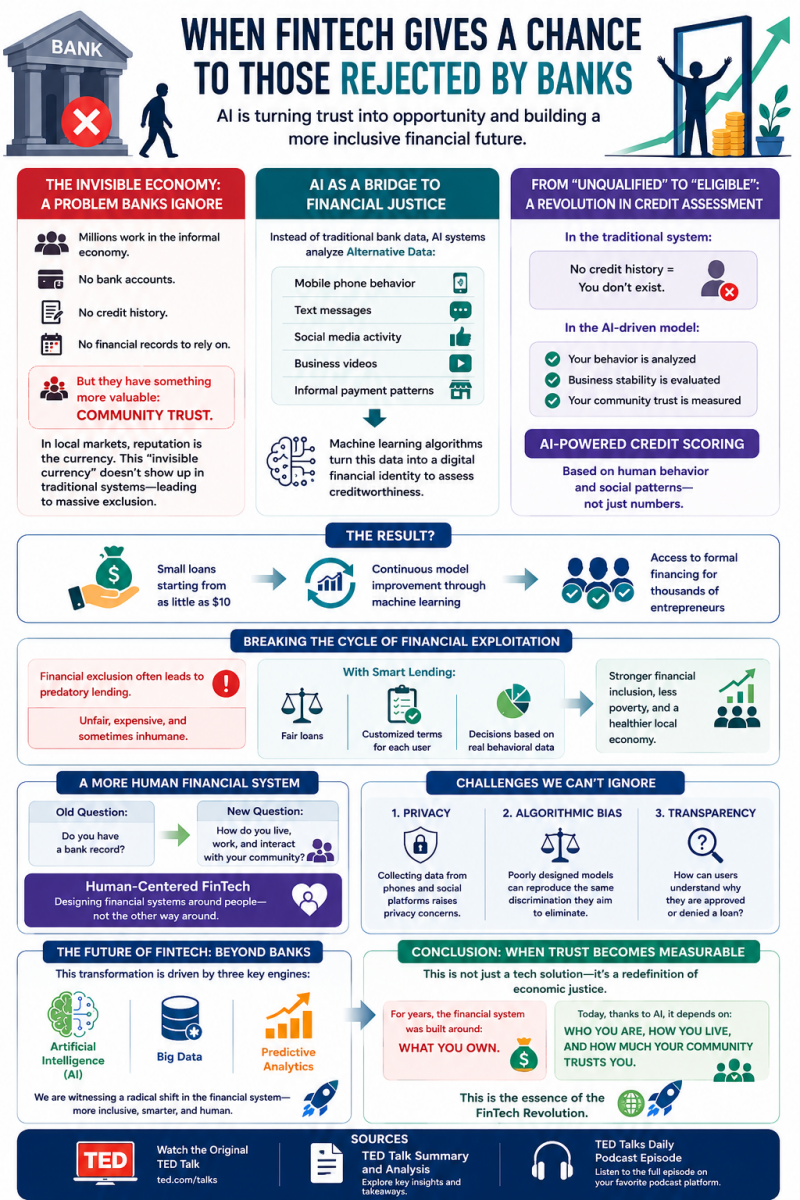
This transformation is driven by three major forces:
- Artificial Intelligence (AI)
- Big Data
- Predictive Analytics
Conclusion: When Trust Becomes Measurable
What this vision offers is not merely a technical solution, but a redefinition of economic justice.
For decades, the financial system was built around one central question:
“What do you own?”
Today, thanks to artificial intelligence, the question is shifting toward:
Who are you?
How do you live?
And how much does your community trust you?
This is the very essence of the coming FinTech Revolution.
Sources
- Watch the original TED Talk
- TED Talk summary and analysis
- TED Talks Daily podcast episode description