Keywords: lifelong learning, staying updated, technology trends
Every day, thousands of new articles, videos, research papers, and social media posts compete for our attention. New technologies emerge, industries evolve, and global events reshape the way we live and work. For many people, the challenge is not finding information—it is finding the right information without becoming overwhelmed.
The good news is that staying updated does not require spending hours online or earning another degree. A few simple habits, supported by reliable resources, can help anyone remain informed, relevant, and confident in a rapidly changing world.
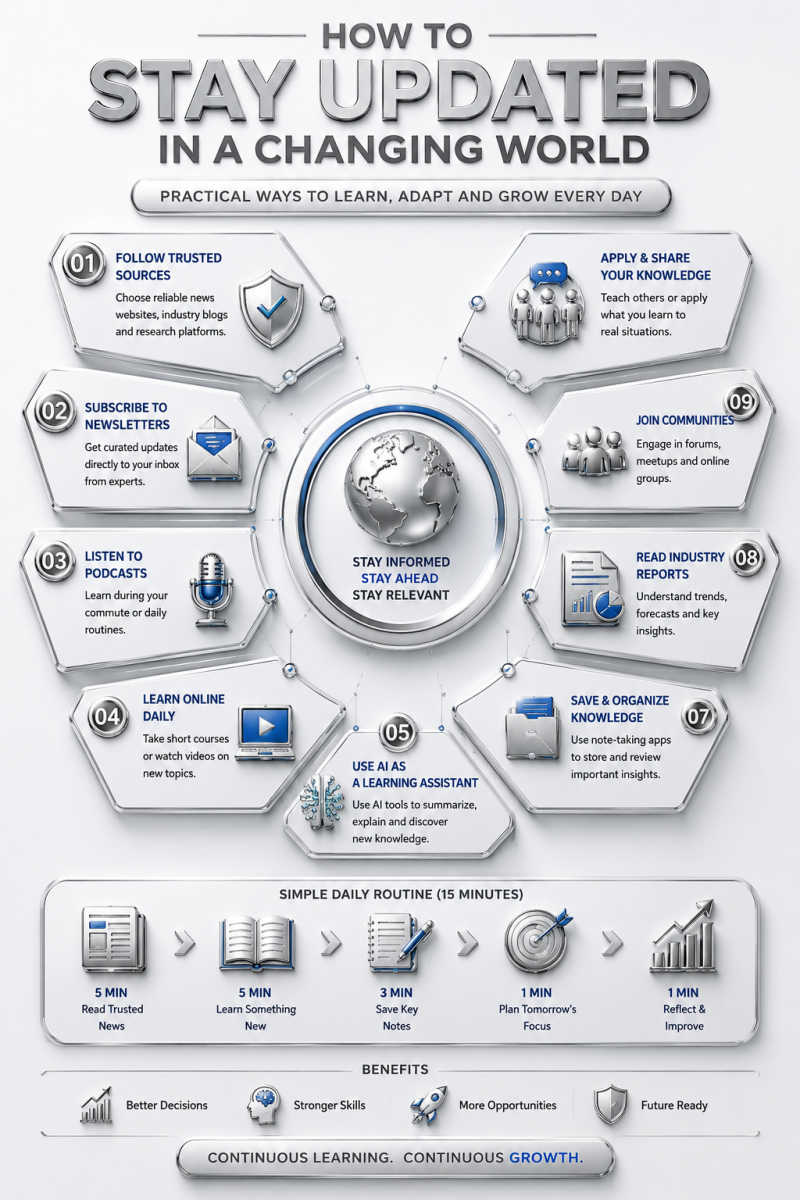
Start with 15 Minutes a Day
One of the biggest mistakes people make is assuming that staying informed requires a major time commitment. In reality, consistency matters more than duration.
Set aside just 15 minutes each day:
- 5 minutes reading headlines from trusted sources.
- 5 minutes reading one article in depth.
- 5 minutes saving notes or key insights.
Over a year, those 15 minutes add up to more than 90 hours of learning.
A practical tip is to connect this habit to an existing routine, such as drinking your morning coffee or waiting for your children during an activity.
Build a Reliable News Diet
Just as healthy food improves physical health, reliable information improves mental and professional growth.
Choose a small number of trustworthy sources instead of endlessly scrolling social media.
Recommended technology and business sources include:
You do not need to read everything. One quality article per day is often enough.
Subscribe to Newsletters Instead of Searching
Rather than constantly looking for information, let information come to you.
Newsletters deliver curated updates directly to your inbox.
Some useful options include:
Many professionals spend less than ten minutes each morning reviewing these summaries and remain surprisingly well-informed.
Turn Commute Time into Learning Time
Podcasts are one of the easiest ways to stay updated without adding extra work to your day.
You can listen while:
- Driving
- Walking
- Exercising
- Cooking
- Doing household tasks
Popular technology and innovation podcasts include:
- Spotify podcasts such as “Hard Fork”
- Apple Podcasts technology shows
- TED Talks Daily
Listening to just three episodes per week can expose you to dozens of new ideas every month.
Follow Experts, Not Algorithms
Social media can either educate or distract.
Instead of following hundreds of accounts, create a focused learning network.
Look for:
- University researchers
- Industry leaders
- Technology journalists
- Cybersecurity experts
- Economists
- Educators
Platforms such as LinkedIn are often more useful for professional learning than endless scrolling on entertainment-focused platforms.
The goal is intentional consumption, not passive consumption.
Use Artificial Intelligence as a Learning Assistant
Modern AI tools can dramatically reduce the time needed to stay informed.
You can ask AI systems to:
- Summarize articles.
- Explain technical concepts.
- Compare technologies.
- Create study plans.
- Generate reading lists.
For example, instead of spending an hour reading ten articles about cybersecurity, you can ask an AI assistant to summarize the most important developments and then explore the topics that matter most to you.
Think of AI as a personal research assistant rather than a replacement for learning.
Create a “Learning Folder”
Many people read valuable information and then forget it a week later.
A simple solution is creating a digital learning folder.
Save:
- Articles worth revisiting.
- Research papers.
- Useful videos.
- Industry reports.
- Notes from webinars.
Applications such as Notion, Evernote, or Microsoft OneNote make organizing knowledge easy.
Reviewing your notes once a month can significantly improve retention.
Learn Through Courses—But Keep Them Short
Many people enroll in long courses and never finish them.
Instead, focus on micro-learning.
Good platforms include:
A 20-minute lesson completed consistently is more valuable than a 20-hour course abandoned halfway through.
Read One Industry Report Every Month
Industry reports often reveal trends before they become mainstream news.
Excellent annual and quarterly reports include:
- Stanford AI Index Report
- Cisco Annual Cybersecurity Reports
- McKinsey Technology Trends Reports
- Deloitte Technology Reports
Reading just one report per month can provide insights that many people never encounter.
Join a Professional Community
Learning becomes easier when surrounded by curious people.
Consider joining:
- Local technology meetups.
- Professional associations.
- Research communities.
- Online discussion groups.
- Industry conferences.
Communities expose you to practical experiences, real-world challenges, and emerging opportunities that are often absent from traditional news sources.
Use the 70-20-10 Learning Rule
Many leadership experts recommend a simple framework:
- 70% learning from real experiences.
- 20% learning from other people.
- 10% learning from formal education.
For example:
- Try a new software tool.
- Attend a webinar.
- Speak with a colleague.
- Complete a short course.
This balanced approach helps transform information into practical skills.
Avoid Information Overload
The objective is not to know everything.
It is to know what matters.
A useful strategy is selecting three focus areas each year.
For example:
- Artificial Intelligence
- Cybersecurity
- Digital Marketing
When new information appears, evaluate whether it relates to your chosen priorities.
This prevents distraction and creates deeper expertise.
A Simple Weekly Plan Anyone Can Follow
Monday
Read one technology article.
Tuesday
Listen to a podcast episode.
Wednesday
Watch a webinar or TED Talk.
Thursday
Read an industry newsletter.
Friday
Save notes and key insights.
Saturday
Experiment with a new digital tool.
Sunday
Review what you learned during the week.
This entire plan requires less than three hours per week yet provides continuous exposure to new ideas and developments.
Final Thoughts
Staying updated is not about chasing every trend or spending endless hours online. It is about creating simple systems that fit naturally into everyday life. A few trusted newsletters, a quality podcast, an organized note-taking system, and fifteen minutes of daily learning can keep you informed and adaptable.
In a world where change is constant, the most successful people are not necessarily the smartest—they are often the ones who never stop learning.
References
- MIT Technology Review — Technology trends, emerging technologies, and innovation.
- Harvard Business Review — Business, leadership, technology, and workplace trends.
- Stanford AI Index — Research and annual data on artificial intelligence trends.
- World Economic Forum — Global technology, economic, and future-of-work trends.
- McKinsey & Company – Technology Trends — Research on technology adoption and digital transformation.
- Deloitte Insights — Research and reports on emerging technologies and business transformation.
- Coursera — Online courses and professional learning.
- edX — University-level online education and professional courses.
- TED Talks — Expert talks covering science, technology, business, and society.
- LinkedIn Learning — Professional and technology-focused learning resources.
- Khan Academy — Free educational resources for continuous learning.
- TLDR Newsletter — Curated technology and software-development news.
- The Rundown AI — AI news, tools, and practical developments.
- Ben's Bites — AI industry news and emerging AI developments.
- Notion — Digital knowledge management and organization.