Robots Between Imagination and Reality
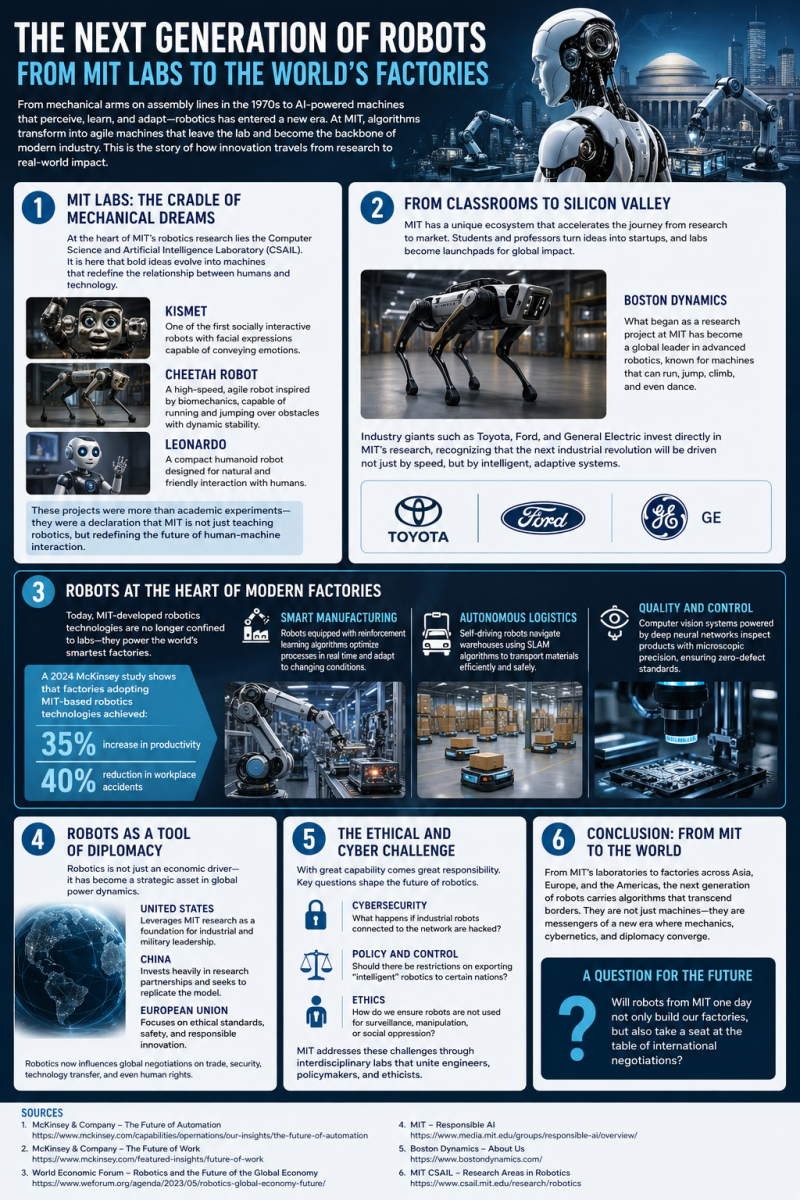
In the 1970s, robots were little more than rigid mechanical arms, rotating methodically along assembly lines with limited adaptability. Today, the landscape has fundamentally shifted. At the Massachusetts Institute of Technology, robots are no longer passive tools; they are intelligent, adaptive systems capable of perception, learning, and interaction.
Within these research corridors, algorithms are not merely written—they are embodied. Data becomes perception, code becomes motion, and artificial intelligence evolves into a cognitive layer that allows machines to interpret and respond to the world around them. This transformation marks a decisive transition: robots are no longer instruments of execution, but emerging partners in decision-making.
1. MIT Labs: The latest Cradle of Mechanical Intelligence
At the core of MIT’s robotics innovation lies the MIT Computer Science and Artificial Intelligence Laboratory, where interdisciplinary research converges to redefine human-machine interaction.
Among its most influential projects:
- Kismet: One of the earliest social robots capable of expressing emotions through facial cues, laying the groundwork for Human-Robot Interaction (HRI).
- Cheetah Robot: A high-speed, bio-inspired robotic platform capable of dynamic running and obstacle navigation.
- Leonardo: A compact humanoid robot designed for natural, intuitive interaction with humans.
These innovations represent more than technical milestones; they signal a paradigm shift in how machines are conceptualized—not as tools, but as responsive, adaptive entities.
2. From Classrooms to Silicon Valley
MIT’s innovation model is defined by its ability to translate research into real-world applications. Academic output does not remain confined to journals—it evolves into startups, patents, and scalable technologies.
A prime example is Boston Dynamics, which originated as a research initiative and grew into a global leader in advanced robotics, producing machines capable of running, climbing, and performing complex dynamic tasks.
Major industrial players actively invest in MIT-driven innovation, including:
These corporations recognize that the next industrial revolution will not be defined by speed alone, but by intelligent, adaptive, and autonomous production systems.
3. Robots at the Heart of Modern Factories
Robotics technologies developed at MIT are now deeply embedded in global manufacturing ecosystems. Their applications extend across:
- Smart Manufacturing: Robots equipped with reinforcement learning algorithms capable of optimizing processes in real time.
- Autonomous Logistics: Self-navigating systems using SLAM algorithms to transport materials efficiently within warehouses.
- Quality Control: Computer vision systems powered by deep learning to detect microscopic defects with high precision.
According to McKinsey & Company, the integration of advanced robotics has led to measurable industrial gains, including increased productivity and reduced workplace incidents.
4. Robots as Instruments of Technological Diplomacy
Robotics has evolved beyond industrial utility into a strategic asset within global power dynamics. Nations increasingly view robotics capabilities as extensions of economic strength and geopolitical influence.
- The United States leverages institutions like MIT to sustain technological leadership.
- China invests heavily in robotics under national industrial strategies.
- The European Union emphasizes ethical governance and regulatory frameworks.
In this context, robotics plays a role in shaping international negotiations related to trade, security, and technology transfer. Machines, once confined to factory floors, are now indirectly influencing diplomatic agendas.
5. The Ethical and Cybersecurity Challenge
As robotics systems grow more autonomous and interconnected, critical concerns emerge:
- Cybersecurity Risks: Networked industrial robots may become targets for cyberattacks, potentially disrupting entire production systems.
- Policy and Control: The question of restricting the export of advanced robotics technologies raises complex geopolitical considerations.
- Ethical Implications: Ensuring that robots are not deployed for surveillance, coercion, or social control remains a pressing challenge.
MIT addresses these concerns through interdisciplinary research initiatives that integrate engineering, ethics, and public policy into the development of responsible AI frameworks.
6. Conclusion: From MIT to the World
From the laboratories of Massachusetts Institute of Technology to factory floors across Asia, Europe, and the Americas, the next generation of robots is reshaping the architecture of global industry.
These systems are not merely machines—they are carriers of a new paradigm where mechanics, artificial intelligence, and cyber diplomacy converge. As their capabilities expand, so too does their influence.
The defining question remains:
Will robots developed at MIT remain confined to building the world’s factories, or will they eventually participate—directly or indirectly—in shaping global negotiations?
Sources
- McKinsey & Company – The Future of Automation
https://www.mckinsey.com/capabilities/operations/our-insights/the-future-of-automation - McKinsey & Company – The Future of Work
https://www.mckinsey.com/featured-insights/future-of-work - World Economic Forum – Robotics and the Future of the Global Economy
https://www.weforum.org/agenda/2023/05/robotics-global-economy-future/ - MIT Media Lab – Responsible AI Initiative
https://www.media.mit.edu/groups/responsible-ai/overview/ - Boston Dynamics
https://www.bostondynamics.com/ - MIT Computer Science and Artificial Intelligence Laboratory
https://www.csail.mit.edu/research/robotics